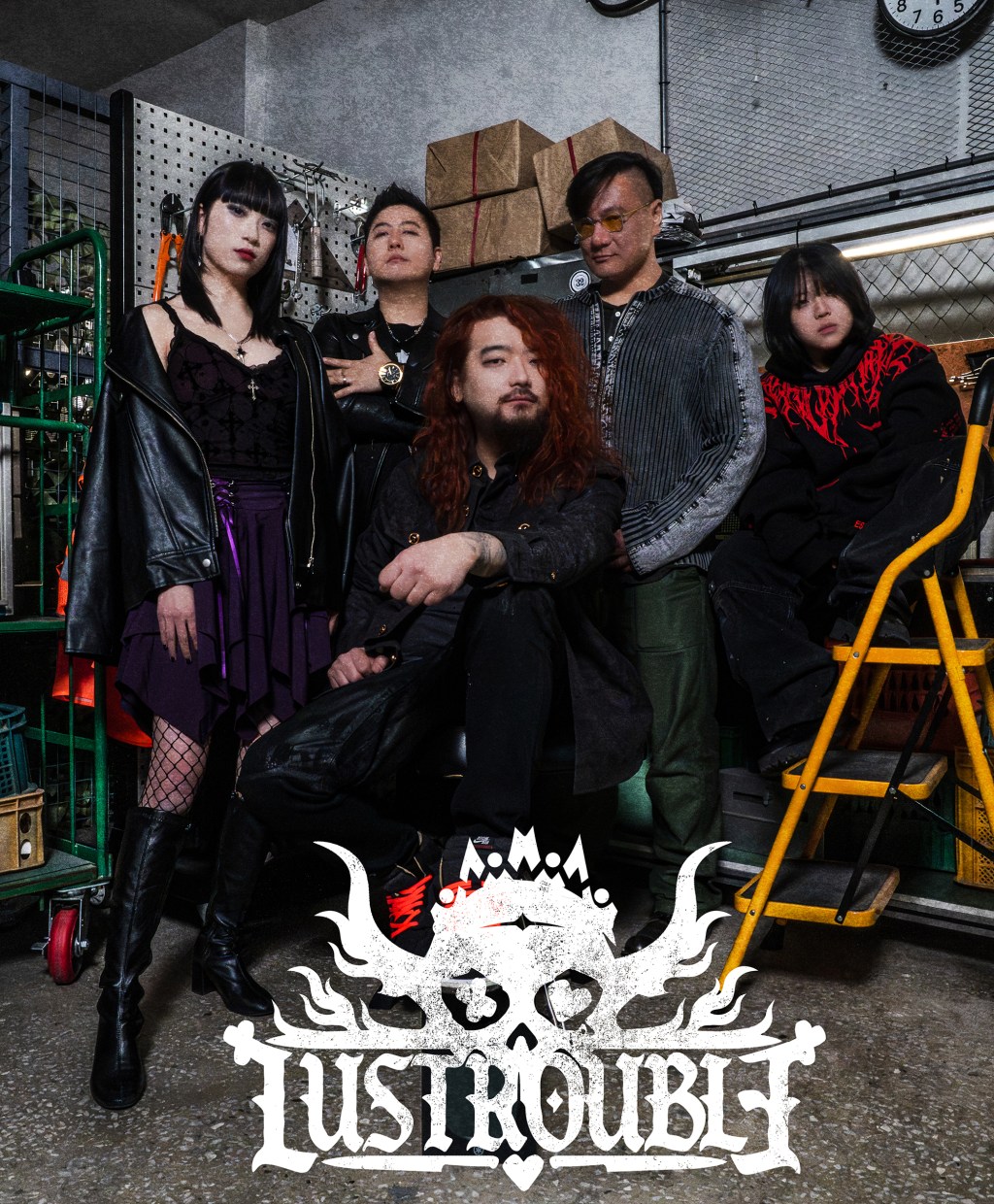
For the finale of this season of City Stories, we’re turning up the volume with LUSTROUBLE (러스트러블), a Korean rock/metal band known for their powerful sound, emotional intensity, and distinctive musical identity.
Since their formation in 2018, LUSTROUBLE has continued to explore the space between love, desire, conflict, and the darker sides of human emotion. Their music blends the energy of rock and metal with melodic and expressive elements, creating a sound that is uniquely their own.
With their latest release, Everything to the End, LUSTROUBLE enters a new chapter while carrying forward the experiences that have shaped them as a band.
We’re honored to sit down with LUSTROUBLE and explore their journey, creative process, latest music, and what lies ahead.
For readers discovering LUSTROUBLE for the first time, how would you introduce the band and describe the kind of music you create?
We’re LUSTROUBLE, a metal band that sings about love and desire. Having both male and female vocalists allows us to tell stories from different perspectives—sometimes from the man’s side, sometimes from the woman’s. And while sexuality is certainly one of the themes we explore, our music is really about desire in a much broader sense: all the different things people want, crave, struggle with, and obsess over.
LUSTROUBLE was formed in 2018. Looking back, what inspired you to start the band, and how has the group evolved since then?
The band basically started with our male vocalist, NOTZ. He was looking for instrumentalists who could also provide backing vocals, but kept running into the same problem: whenever he tried to put a band together, he could never find a guitarist who could play and sing the backing parts he wanted. Eventually, he decided he might as well become the backing vocalist himself.
There was also a memory that stuck with him for years. He once heard Evanescence’s “Bring Me to Life,” bought the CD, and then discovered that it was basically the only song on the album built around that kind of male-female vocal interplay. That eventually inspired the idea: why not make a band where every song features both male and female vocals?
And somehow, that idea brought us all the way here. Now even Linkin Park is following our lead. [Laughs]
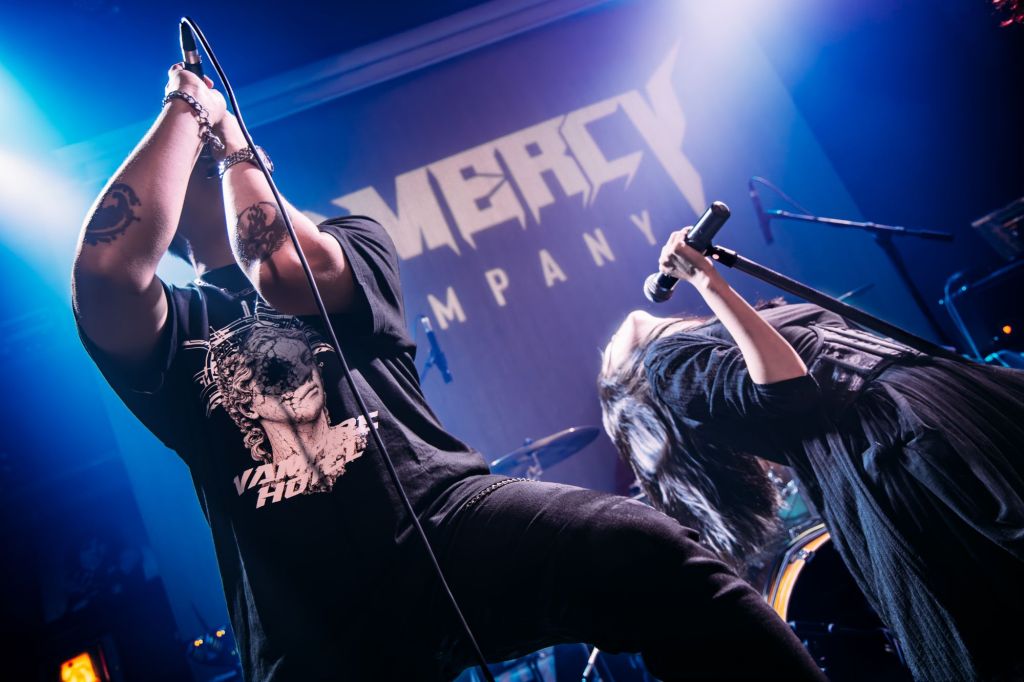
The band has a distinctive combination of male and female vocals. How did this become an important part of LUSTROUBLE’s musical identity?
A lot of modern post-hardcore is built around the contrast between unclean and clean vocals, and we’ve always felt that a male-female combination is one of the best ways to bring that contrast to life. Our male vocalist can scream his lungs out, while our female vocalist comes in with cleaner vocals than just about any male singer could deliver.
The balance also changes depending on the song. If we’re writing something designed to make metalheads bang their heads, the male vocalist usually takes a bigger role.
If we want a song to have a more accessible, pop-oriented appeal, the female vocals tend to take up more space.
Your music brings together elements of rock, metal, alternative rock, and other styles. How would you describe the sound you have developed as a band?
We usually start with the story or message we want the song to convey, rather than committing ourselves to one particular genre. “Not a Love,” for example, was based on a letter our female vocalist wrote to an ex-boyfriend after a breakup, while “Sunflower” was based on a real breakup experienced by our male vocalist.
Once we know what we want to say, we choose whatever language within rock and metal serves that story best. So rather than defining LUSTROUBLE by a fixed genre, we think of our sound as something that changes according to the emotion and story each song needs.
The name LUSTROUBLE combines ideas associated with desire and conflict. What does the name mean to the members, and how does it connect with your music?
We spent a lot of time coming up with a name that could capture the identity of a band with both male and female vocals, and people have complimented us on the name quite a lot over the years.
We created a completely new proper name by combining two words—“lust” and “trouble.” One thing we like about that is that if you search for “LUSTROUBLE,” you only find us. It belongs entirely to the band. We think the name and the identity of our music fit together almost perfectly.
When writing a new LUSTROUBLE song, where does the creative process usually begin—lyrics, melody, a guitar or instrumental idea, or something else?
Usually, it starts with either a guitar demo or a vocal demo, and then everyone gradually adds their own parts. All of our ballads were written by our male vocalist, while most of the heavier metal songs were composed by our guitarists.
From there, we focus on taking whatever emotion the original demo gives us and connecting it with a melody that people will remember. No matter how heavy a song gets, we still care a lot about creating something catchy.
Your songs often explore intense emotions and relationships. What kinds of real-life experiences or emotions tend to inspire your songwriting?
“Not a Love” and “Sunflower,” which are our ballads, are the songs that are directly based on real experiences. With most of our other material, the inspiration works in the opposite direction: we listen to the music first and try to understand what kind of imagery it creates.
We might hear a destructive guitar demo and think, “This sounds like cheating,” or “This feels like a breakup.” Our imagination naturally gravitates toward relationships, love, sex, betrayal, and everything that can go wrong between people. Then we build the story around whatever emotion the music gives us.
How do the different musical tastes and personalities of the members influence the final sound of a LUSTROUBLE song?
One of the most enjoyable—and painful—parts of being in a band is figuring out how to combine everyone’s different tastes. Fortunately, most of us in LUSTROUBLE agree that making music that feels current is more important than forcing every individual preference into a song.
That said, both of our vocalists are huge Linkin Park fans, so there is definitely some common ground there.
Is there a particular LUSTROUBLE song that you feel represents the band most accurately? Why?
“Room No.506” probably captures LUSTROUBLE better than any other song we’ve made.
You could probably count the number of Korean metal songs explicitly dealing with sex on two hands, and the fact that we sing it in Korean gives the song an identity of its own.
More than anything, it deals with exactly what our name suggests: a lusty kind of trouble. That’s why we almost always play it as our closing song, with the audience singing along with us.
What do you hope listeners feel or take away after listening to your music for the first time?
We’re aiming for a certain level of spice—enough to feel like metal, but not so extreme that someone who normally thinks metal is just noise immediately walks away. We want those people to hear us and think, “Actually, I can handle this.”Most metalheads are pretty forgiving when a metal song becomes accessible or melodic.
General listeners are often the opposite: if there’s no melody to hold onto, they leave. That’s one reason we sing so much about relationships. Love, breakups, desire and jealousy are things almost everyone can understand.
Ultimately, we want people to think of LUSTROUBLE as metal that anyone can approach.
Everything to the End
Your latest release, Everything to the End, came out in April 2026. What does this new release represent for LUSTROUBLE at this point in your career?
What makes this release particularly meaningful is that it was completed by the lineup we have today.
“Everything,” written by our current guitarist Jeff, has already become one of our signature live songs and gives us a chance to really interact with the crowd. “Welcome to the End,” on the other hand, is a much more experimental track that has received a lot of praise from people within the music industry for its musical craftsmanship.
So in many ways, this release feels like the beginning of the current version of LUSTROUBLE.
What was the biggest difference between making Everything to the End and your earlier releases such as We Love Hate and Monster in Motel?
The biggest difference was the people involved in creating it. Our current guitarist Jeff has a very different approach to songwriting. Rather than simply writing whatever comes to him in the moment, he researches, experiments, and keeps working until the song becomes what he originally intended it to be.
Everything to the End marks the beginning of that collaboration with Jeff. FX and synthesizers also became a bigger part of our sound with this release, and you can expect those elements to continue appearing in our music from here on.
The title Everything to the End immediately creates a strong and dramatic image. What is the story or message behind the title?
The title is actually a combination of the titles of the two completely new songs on the release: “Everything” and “Welcome to the End.” “Room No.506” was a newly recorded version of an existing song, so we took the titles of the two brand-new tracks and combined them.
It works as one album title, but at the same time, anyone familiar with the songs can immediately figure out what’s inside.
Among the three tracks on Everything to the End, is there one song that holds a particularly special meaning for the members?
“Welcome to the End” feels particularly special to us. We consider it one of Jeff’s finest pieces of work.
The song begins with this dark, almost frightening atmosphere, but then suddenly opens up and becomes brighter when the chorus arrives. That contrast gave us the image of someone standing at the end of the world and deciding, “Well, if everything is ending anyway, I might as well enjoy it.”
Musically, the song put our vocalists through a serious test. We’re proud to say they passed.
How did you approach balancing the heavier side of LUSTROUBLE with the melodic and emotional elements found throughout the new release?
Once a demo is developed enough for us to understand its overall atmosphere, we can usually tell how “spicy” the song is going to be.
Songs with a medium level of spice often become the lead tracks we choose for music videos, and those usually feature more of our female vocalist. As we move toward the heavier end of the spectrum, we reduce the amount of melody. On some of our hardest material, even our female vocalist joins the male vocalist in the unclean sections.
So the vocal balance itself becomes one of the tools we use to control how heavy or melodic a LUSTROUBLE song feels.
LUSTROUBLE has been part of Korea’s rock and metal scene for several years. How would you describe the current Korean underground rock scene from your perspective?
Survival here depends heavily on cooperation. What’s surprising is how small and fragile that ecosystem can seem, and yet it has managed to keep going for a very long time.
There are fewer clubs, promoters, and venues than in many other genres, but there is a small and extremely loyal audience. There are also YouTube channels and creators who voluntarily film performances and produce content around the scene. Clubs, promoters, bands, fans, and creators all depend on one another, and the scene continues to grow through that relationship.
There was a time when metal was largely abandoned by the Korean mainstream, and to be fair, the artists themselves probably weren’t entirely blameless. But the quality of the Hongdae metal scene today is higher than it has been in a very long time, and we’re gradually seeing audiences grow again.
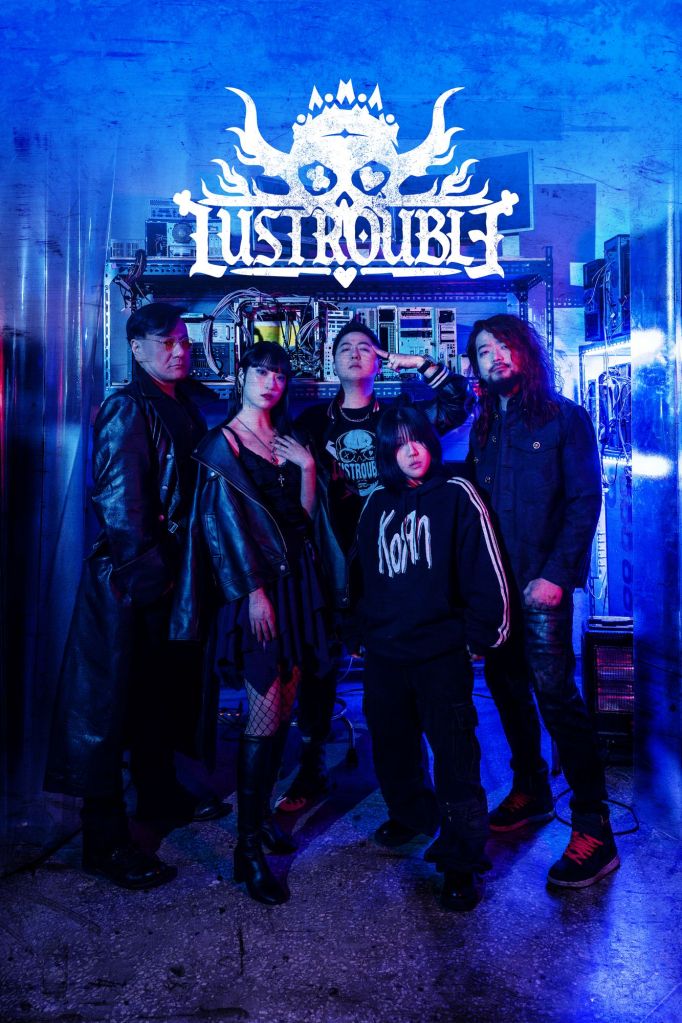
What is different about performing LUSTROUBLE’s music live compared with recording it in the studio?
Korean audiences are almost obsessed with high notes, and LUSTROUBLE isn’t completely immune to that culture either. At the same time, we’ve seen well-known bands create songs they struggle to reproduce convincingly onstage, so we try to be careful about that.
Live, we sometimes use backing tracks, and the members will also cover one another’s vocal parts when necessary. Our priority is to recreate the density and impact of the original recording without leaving holes in the sound.
But there’s another singer in LUSTROUBLE at every show: the audience. Even when we share the bill with bands much bigger than us, we take pride in making LUSTROUBLE’s set one of the loudest and most energetic moments of the night.
What has been one of your most memorable performances or moments as a band so far?
Winning the first metal competition organized by the No Mercy label is still one of our most memorable experiences. It felt like proof that the vision we had for this band wasn’t wrong, and our recognition within the scene grew very quickly after that.
Metal Collection is another memory that has stayed with us. It gave us an opportunity to perform outside Seoul, and fans there—people we had never met before—already knew our lyrics and shouted them back at us.
The Korean rock scene is heavily centered around Hongdae, so even traveling to perform in other regions can feel unusual. That made the welcome we received there especially meaningful, and it has stayed with us ever since.
As a Korean rock/metal band, what do you hope international listeners discover about LUSTROUBLE and the Korean rock scene through your music?
K-pop has brought an incredible amount of international attention to Korean music. Rolling Quartz, who are doing a lot to raise the profile of Korean rock internationally, once gave us a piece of advice: overseas fans may actually appreciate hearing us sing in Korean even more.
There’s also a famous line from Parasite director Bong Joon Ho about overcoming the barrier of subtitles and discovering many more amazing films. We think music can work in much the same way.
There are so many incredible bands in Korean metal right now. Some have gone even further than us in pursuing international audiences and perform entirely in English. But Korean rock bands as a whole are still underrated.
I sometimes think of us as thorn-covered roses growing in an empire of ballads. We hope metal fans overseas who appreciate the sharpness of those thorns become curious enough to explore Korean rock.
When I was younger, I used to sit with a dictionary and work my way through the English lyrics of foreign bands I loved. I hope listeners overseas will make that same journey with Korean bands—and discover very quickly that Korean music has much more to offer than dance-pop.
Finally, what can fans expect from LUSTROUBLE next? Are there plans for new music, live performances, collaborations, or international activities?
For the first time, LUSTROUBLE is currently working on new music that will feature guest artists. Those collaborations may include both Korean and international musicians.
Collaboration has actually played an important role in LUSTROUBLE outside the music itself as well. Renowned webtoon artist Junho Park, whose work is currently serialized through Naver Webtoon and LINE WEBTOON, has created our album artwork. Our T-shirts have also received a lot of love, featuring a logo designed by SOOO, the designer for the well-known DJ crew DEAD END.
Our music has also crossed over into professional wrestling. “Room No.506” was used as an event theme for the Korean wrestling promotion PWS, while “Get Sick” became the Korean theme song for WWE NXT. More recently, “Everything” was used as a Korean theme for AEW Dynamite, giving us another opportunity to connect with a wider audience.
Our own branded show, Bad Girls United, will celebrate its fifth edition this Halloween. Female-fronted bands often have large male fanbases, but at mixed bills they still tend to find themselves surrounded by male vocalists. We wanted to turn that around and create a night where audiences could experience a whole range of female vocalists in one place. The event has received a lot of love, and with this edition taking place on Halloween, we’re planning something even more special. Expect striking performers, distinctive music, and a night filled with bands that have identities of their own.
Every member of our current lineup is eager to perform overseas, and we’ve already received some offers. But our biggest goal right now is our first full-length album. When that record is ready, we intend to use every connection and every network we have to pursue every opportunity available to us. Wherever the call comes from, we want to answer it.
LUSTROUBLE began as a group of strangers brought together by music, and somewhere along the way, we’ve started becoming a family. We only get one life. When the day eventually comes for us to look back on this band, we want there to be a lot to remember—and as little as possible to regret.


Leave a comment