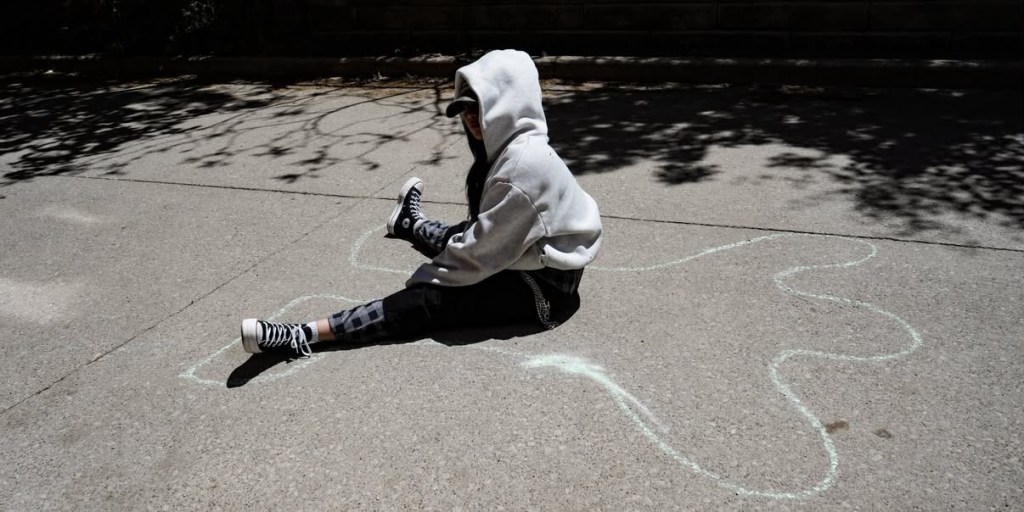
For LESS KILLJOY, music is a space for honesty, emotion, and unapologetic self-expression. Blending the rawness of grunge, the intimacy of indie rock, the dreamy textures of shoegaze, and the immediacy of pop, the artist refuses to be confined to a single genre or sound.
Inspired by artists such as Paramore and PVRIS, LESS KILLJOY transforms deeply personal emotions and experiences into songs that can resonate on a universal level. With curiosity, connection, chaos, fun, and feeling at the heart of the project, LESS KILLJOY is carving out a sound that feels entirely their own.
In this City Stories interview, LESS KILLJOY opens up about the meaning behind the name, musical influences, songwriting, and the journey of creating music without having to fit neatly into one box.
For readers discovering your music for the first time, how would you introduce LESS KILLJOY?
LESS KILLJOY is an alternative artist making music for people who feel a little too much and think a little too much.
The project lives somewhere between grunge, indie rock, shoegaze and alternative pop, but at its core, it’s about emotion, identity, and finding a sense of belonging.
I want the music to feel like a place where you can be messy, complicated, angry, heartbroken, hopeful-all of it.
What inspired you to create the LESS KILLJOY project, and what does the name represent?
LESS KILLJOY came from wanting to create something that felt completely honest and unapologetic. The name is almost a challenge to myself—to stop overthinking everything, stop worrying about whether I’m being too much, and allow myself to actually enjoy being alive.
There’s also something intentionally contradictory about it. A killjoy is someone who takes the fun out of things, and I think I’ve spent a lot of my life being my own killjoy. LESS KILLJOY is about pushing against that. It’s about choosing curiosity, connection, chaos, fun, and feeling instead.
Your music blends grunge, indie rock, shoegaze, and alternative pop. How did you develop this unique sound?
I don’t think I ever consciously sat down and decided, “I’m going to make this particular genre.” I’ve always been drawn to music that feels emotional and atmospheric, but still has something really visceral about it.
I love the heaviness and rawness of grunge, the intimacy of indie rock, the dreamy textures of shoegaze, and the immediacy of pop. LESS KILLJOY became a place where I could let all of those influences exist together without having to fit neatly into one box.
Which artists or albums have had the biggest influence on your songwriting and production?
A lot of alternative artists have shaped the way I think about music, particularly artists who aren’t afraid to be both melodic and aggressive. Paramore has been a huge reference point for me, especially in the way they balance vulnerability with energy and huge hooks.
I’m also drawn to artists like PVRIS and the darker, atmospheric side of alternative music. More than trying to sound exactly like any one artist, I’m interested in taking the things I love from different places and turning them into something that feels like LESS KILLJOY.
Your songs often carry emotional themes. How personal are the stories you tell through your music?
Very personal—but not always literally autobiographical.
Usually, there’s a real emotion or experience at the centre of a song. Sometimes it’s something that happened to me, sometimes it’s a feeling I’ve lived through, and sometimes I take an experience and turn it into something bigger and more universal.
I think that’s the point of songwriting for me. I can take something incredibly specific and personal and turn it into something that another person hears and thinks, “Oh my god. That’s me.”
Is there a song in your catalog that holds the deepest meaning for you? Why?
I think LONELY HEARTED is becoming one of the most meaningful songs for me because it represents a very specific emotional experience that so many people have lived through—the feeling of being attached to someone who can’t fully meet you where you are.
What’s important to me about the song isn’t just the heartbreak. It’s the realization that you can’t abandon yourself just because you want someone else to choose you.
That’s something I really want LESS KILLJOY to represent: you can be devastated by something and still choose yourself.
How do you know when a song is truly finished and ready to be released?
I have to get to the point where I’m no longer trying to make the song “better” just because I’m afraid to let it go.
There’s always something you could change. Another vocal take, another production detail, another lyric. Eventually you have to recognize that the song has said what it needed to say.
For me, a song is finished when changing it starts to take away from what made it feel alive in the first place.
What does your songwriting process usually look like—from the first idea to the final recording?
It can start anywhere—a lyric, a melody, a voice memo, a guitar idea, or even just a feeling I can’t stop thinking about.
I’ll usually capture the idea before I understand what the song is actually about. Then I start pulling at that thread: what am I really trying to say? What is the emotional centre of this?
From there, the song develops through writing and production. I like letting the production become part of the storytelling rather than treating it as something separate from the lyrics.
How has your sound evolved since releasing Pink Grenade?
I think I’ve become much more confident in allowing LESS KILLJOY to be its own world.
Pink Grenade was an important part of figuring out the identity of the project, but since then I’ve become more interested in atmosphere, contrast and emotional depth. I’m less concerned with making everything fit into one genre and more interested in making something that feels unmistakably like me.
There’s still the aggression and alternative edge, but I think the newer music has more space, texture and vulnerability.
Many listeners connect with the honesty in your lyrics. What message do you hope they take away from your music?
You don’t have to have yourself figured out to deserve to be here.
I want people to feel less alone. I want someone to hear a song and feel like somebody finally put words to something they’ve been carrying around silently.
And I want LESS KILLJOY to remind people that being sensitive, complicated, angry, emotional or different isn’t something you need to apologize for.
How do live performances differ from recording in the studio for you?
Recording is very internal for me. I’m obsessing over tiny details and trying to capture exactly what I hear in my head.
Live performance is the opposite. It’s physical. It’s immediate. There’s an exchange happening between me and the audience, and the songs become bigger than they were when I wrote them.
I love that a live version doesn’t have to be perfect. It just has to be alive.
Have there been any memorable fan interactions that reminded you why you make music?
Absolutely. The moments that stick with me are when someone tells me that a song made them feel understood, or that they heard themselves in something I wrote.
That’s the part that never gets old. When you’re writing a song, you’re usually alone with your own thoughts. You don’t necessarily know whether anyone else will understand them.
Then someone comes up to you and says, “I know exactly what you mean.”
That’s when it stops being just my story.
Your visual aesthetic is distinctive. How important is visual storytelling to the LESS KILLJOY experience?
Extremely important. I don’t see the music and the visuals as separate things.
I want LESS KILLJOY to feel like a world you can step into. The colours, photography, videos, styling, artwork and live shows should all communicate something before you’ve even heard the song.
The goal isn’t just to make things look cool. It’s to create an emotional atmosphere that makes the music feel bigger.
What has been the biggest challenge you’ve faced as an independent artist, and how did you overcome it?
One of the hardest parts is realizing how much work happens outside of actually making music.
As an independent artist, you’re the songwriter, artist, creative director, marketer, strategist, performer and often the person sitting behind a computer trying to figure out what the hell you’re supposed to post that day.
I’ve had to learn that building a career isn’t just about being talented. It’s about consistency, resilience, learning how to delegate, and continuing even when the immediate results aren’t there.
I’m still learning that.
Are there any genres or musical styles you’ve been wanting to explore in future releases?
Definitely. I don’t want LESS KILLJOY to become predictable.
I’m interested in continuing to explore darker electronic textures, heavier guitar-driven music, dreamier shoegaze elements and more experimental production. I also want to find ways to incorporate pop sensibility without losing the weirdness and edge that make the project feel like me.
If you could collaborate with any artist or band, past or present, who would it be and why?
Paramore would be an incredible collaboration for me.
I admire the way they’ve managed to evolve without losing their identity. They’ve made music that can be huge and accessible while still feeling emotionally honest and alternative.
I’d love to be in a room with artists who understand that tension between vulnerability and power.
What keeps you creatively motivated during periods of writer’s block or self-doubt?
I try to remember that I don’t have to feel confident to keep going.
There are absolutely moments where I question whether I’m good enough, whether anyone cares, or whether I’m wasting my time. But I’ve learned that those feelings aren’t necessarily telling me the truth.
Sometimes the best thing I can do is stop trying to force a masterpiece and just make something. A bad voice memo is better than no voice memo. A weird idea is better than waiting for the perfect one.
The goal is to keep moving.
What can fans expect from your upcoming music and future projects?
LONELY HEARTED is coming September 18, 2026, and it’s a really important next step for LESS KILLJOY.
It’s a song about that particular kind of heartbreak where you know there is a connection, but you also know that connection isn’t enough to make the relationship possible.
Beyond that, I’m continuing to build out the world around LESS KILLJOY-more music, more live shows, more visual storytelling and, most importantly, more opportunities for people to connect with the project beyond just streaming a song.
What are your goals and aspirations for LESS KILLJOY over the next few years?
My biggest goal is to make LESS KILLJOY my full-time life.
I want to build an audience that isn’t just made up of followers, but actual fans who feel connected to the music and to the community around it. I want to play bigger shows, release music consistently, create incredible visual worlds around the songs and eventually reach a point where this project can support itself—and support the people working alongside me.
Ultimately, I want LESS KILLJOY to become a place where people feel like they belong.
Do you have a message for your fans, and what advice would you give to aspiring musicians who are just beginning their journey?
To anyone listening: thank you for giving my music a place in your life. I don’t take that lightly.
And to anyone starting out as a musician, don’t wait until you feel ready. You probably won’t.
Make the song. Play the show. Post the video. Put yourself out there. Learn. Make mistakes. Make something embarrassing. Make something amazing. Keep going.
You don’t need everyone to understand what you’re doing. You need to understand why you’re doing it, and then keep showing up long enough for the right people to find you.
That’s what I’m trying to do with LESS KILLJOY, too.


Leave a comment