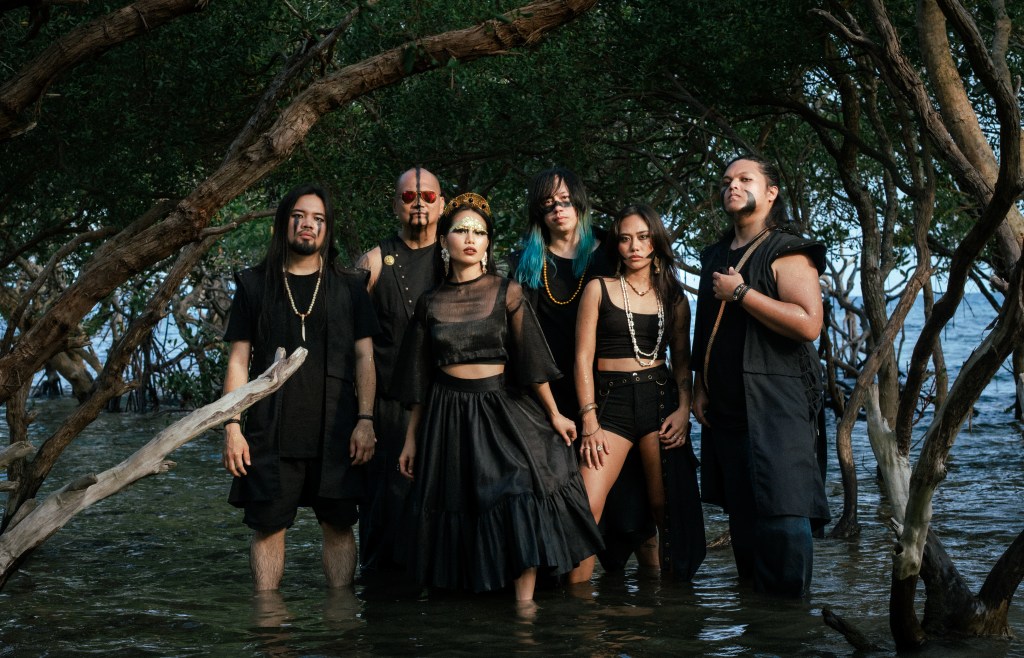
Hailing from Cebu, Adamanta brings together powerful metal, epic storytelling, and Filipino and Visayan heritage.
With a sound inspired by mythology, history, and the warrior spirit of the Visayas, the band continues to carve its own path in the Philippine metal scene.
For City Stories: Finale Band Edition, Adamanta shares their musical journey, inspirations, and the stories behind their sound.
This is Adamanta’s story.
For readers discovering Adamanta for the first time, how would you describe the band and the kind of musical world you want to create?
We wanted to put on a heavy metal show that did not take itself too seriously.
We realized we had reached the peak of the dark, brooding persona, but there was a massive audience of nerdy, theatrical metal fans who felt left out because the local scene was not welcoming to that style.
So, we embraced those nerdy tropes and anchored them in Filipino mythology, culture, and traditional regional instruments.
Adamanta began as Chrono Storm X before becoming Adamanta. What inspired the transformation, and how has the band’s identity evolved since 2016?
Chrono Storm X was our first attempt at that nerdy style, but it did not feel completely genuine to who we were. We were singing about epic battles set in distant galaxies, which made it hard to fully connect with the material.
Everything changed when our guitarist was listening to Valhalla by Blind Guardian on repeat and realized we should be writing epic anthems specifically for Filipinos.
The band’s music blends power metal, symphonic elements, and Filipino folk influences. How did you arrive at this distinctive sound?
Our genre description ended up so long simply because our band leader draws inspiration from everywhere, including classical pieces, film scores, video game soundtracks, and power metal.
When you weave all of those influences together with motifs from traditional Filipino instruments, that’s the Adamanta sound. We get some comments like “that sounds celtic” or “that’s irish” where in fact, it’s JRPG town music mixed with popular Cebuano anthems like the Sinulog song.
What does being a Cebu-based metal band mean to Adamanta, especially within the growing music scene in Cebu?
We are deeply proud of our roots, so starting with local mythology and representing historic Cebu was important to us. Cebu has a tough music scene. It is small, highly competitive, and packed with incredible talent.
Cebuano audiences are notoriously hard to impress, which makes it the ultimate testing ground. If your music can survive here, it can make it anywhere. Adamanta had to go through that local slogfest to become what it is today.
A major part of Adamanta’s identity is your use of Filipino history, mythology, and pre-colonial culture. What drew you to these stories in the first place?
A movement to reconnect with precolonial Filipino history was already building online, and our band leader’s upbringing in Papua New Guinea gave us a unique perspective on cultural identity.
In school, we learn about colonization, wars, and political revolutions, but digging deeper into our ancient roots felt like a personal calling. We felt a real urgency to preserve, own, and share those stories before they fade away.
Your music often highlights Visayan heritage and the warrior spirit of our ancestors. What aspects of Visayan culture do you feel deserve more attention from today’s generation?
The phrase “naa man na sa atua” or “we have that at home” is something made fun of like “Jollibee” vs “Jollibee at home” but there is knowledge and wisdom from our own land that also needs to be referenced or consulted.
To be stubborn, prideful, and not over complicating everything is also very Bisaya since so many of us today get “analysis paralysis” or are too deep into the “hustle culture” that they forget to appreciate what they’ve already achieved or forget to apply what they already studied.
With songs such as “Conquer,” you have transformed historical and cultural themes into metal music. How do you balance historical inspiration with your own creative interpretation?
Creatively, we try to give ourselves complete freedom. We were fortunate to find a blend of genres that serves as the perfect vessel for our storytelling and is something we genuinely love playing. We also had to accept that some historical records are incomplete, and that is precisely where artist interpretation comes in.
Stories naturally evolve over time, and while our historical records might not be as vast as those in Western or East Asian history, that gap gives us room to imagine and create.
How important is storytelling to Adamanta’s songwriting? Do you usually begin with a story or concept, or does the music come first?
We start with a grand story in mind to anchor everything down then write several songs that we feel might fit a certain part of the story.
We have a lot of songs that we had to put on the wayside simply because they didn’t fit the album.
Your upcoming concept album Follow the Brave explores an epic narrative involving characters such as the Highland Queen and Mambabarang. What can you tell us about the world and story behind the album?
The album is set in Filipino precolonial times and revolves around themes of fate and duty.
It’s around the time of the eclipse with characters having complicated motivations.
Even though the album is titled Follow The Brave and feels like the opening chapter, it is actually the middle of the broader story.
What inspired the character of the Highland Queen, and what does she represent within the story?
We came to a theory that a remote barangay in Cebu City was owned by a “binukot”. So our imagination ran. We looked through several writings about ancient mountain people and came up with “The Highland Queen”.
She represents the optimistic innocence and the divine right to revenge in Filipino mythology and how even the best of intentions, even those coming from love, can have the worst of consequences.
“The Omens of Doom” introduces Mambabarang as the antagonist. What made this particular figure compelling enough to become part of Adamanta’s mythology?
We realized the story needed a contrasting force. The Highland Queen is the typical heroic dragon slayer archetype and the Bakunawa is just hungry for the moon. There was no urgency or motivation until we realized we needed an opposite.
A calculating, opportunistic mastermind that uses anything in his power to control everything unlike The Highland Queen who is just looking to survive and protect her people. The duality of The Highland Queen and Mambabarang are like an eclipse in its own way.
How does Follow the Brave differ musically or conceptually from your previous releases?
“Follow The Brave” has been a decade in the works. We don’t have previous releases to compare it to but if we were to compare it to the other songs that didn’t make the album, it’s a lot simpler, more direct, and sincere. We wrote this album for ourselves and if a song did not feel genuinely authentic or push the theme forward, it didn’t make the cut.
Creating a roughly 50-minute concept album is an ambitious undertaking. What has been the biggest challenge in turning such a large story into music?
The hardest part was trying not to over explain everything in the lyrics.
There are just so many ideas that we wanted to share, but we also don’t want to overwrite a song since that wouldn’t be very fun for the listener.
Adamanta’s music has a cinematic quality that can feel almost like a soundtrack to an epic film. What artists, composers, films, literature, or other forms of storytelling have influenced this approach?
Easily the composers that have had the biggest influence are Howard Shore from the Lord of The Rings movie franchise, John Williams, Miguel de Loarca’s “1582 Relación”, the boxer codex, old school RPG’s, and video game soundtracks.
How do you incorporate Filipino or Visayan musical elements into a metal framework without losing the intensity and character of the genre?
This is something we’ve struggled with a lot. Not only is putting Filipino musical elements in the context of an orchestra difficult, mixing in heavy metal drowns it out so we give the Filipino instruments space for it to shine in the song writing. Finding ways to elevate those humble, traditional sounds alongside a large orchestral metal framework is the precise challenge we love tackling. When it works, it’s very satisfying. When it’s a dud, it’s very frustrating.
As musicians working within a genre that is still relatively niche in the Philippines, what challenges have you encountered in building an audience for symphonic/folk metal?
Ironically, local footing is still our major challenge. A good chunk of our listeners and fans are actually people from outside the Philippines.
We’re too heavy for popular Filipino festivals and we’re too melodic for typical Filipino metal shows. We had to carve out our own space. We’re fortunate we did because what used to be our weakness of being a niche band turned out to be our greatest strength
What has been one of Adamanta’s most memorable live performances so far, and what made that experience special for the band?
There are so many. The Renaissance Faire shows in Baguio and Singapore are up there in terms of memorability but our biggest learning experience was the Wacken Battle in 2023.
It was our largest stage, and everything went wrong. Members fell ill, our vocalist fainted mid performance, and a bass string snapped less than an hour before showtime. It was a rough set. We knew we had to step up after that show.
Looking at the current Philippine metal scene, what excites you most about the next generation of Filipino metal musicians?
The revival of Nu Metal and Hardcore in the local scenes is exciting to watch. More Filipino musicians are taking creative risks and are expressing their anger in a healthy way again. Also, the amount of world class artists involved in smaller local metal projects makes the metal soundscape so fun now.
If someone listens to Adamanta and becomes interested in Filipino mythology, Visayan history, or pre-colonial culture, what would you hope they take away from your music?
Learn and embrace Filipino culture from wherever you can get your hands on it. There are just so many stories and places to enjoy that it would be a shame to lose it. Learning our pre-colonial history also teaches us why we think and do certain things despite the meanings being wiped out because of the near erasure of our history.
Looking ahead, what is the ultimate vision for Adamanta? Where do you hope the band and its stories will be five years from now?
The ultimate vision of Adamanta would be to be able to play with a full orchestra, to make more music, and to be able to tell the world that being Filipino is hella cool.
 Welcome to City Writer
Leave a comment